After spending three years studying Chemical Engineering at the University of Bath, I chose to take on a placement year at FairHeat before returning to complete my Master’s degree. I was keen to gain experience in industry and better understand how the theory I had learnt at university is applied to real engineering challenges.
I was first introduced to the concept of heat networks during an Extended Project Qualification (EPQ) at school, where I explored future low carbon heating technologies for the UK. Before starting this project, I assumed the options were limited to heat pumps and hydrogen. However, my research showed that heat networks are often the most effective solution for supplying heat to areas with dense heating demand such as cities, with individual heat pumps supplying the rest.
At university, it can sometimes be difficult to see how conceptual knowledge is applied in practice. My placement at FairHeat has helped bridge that gap, allowing me to work on live projects and understand the real‑world impact of engineering decisions — not just on systems, but on the people connected to them.

1. Compliance
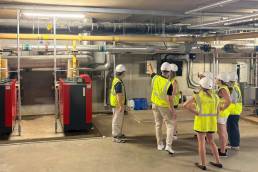
For the first six months of my placement, I worked in the Compliance team, focusing on improving the performance of existing communal heat networks. I worked on a wide range of projects, including systems serving cathedrals, universities, town halls, luxury apartment buildings, prisons and retirement homes – exposing me to many different building types and operating challenges.
Many communal heating systems across the UK perform poorly. Unfortunately, many residents face overheated homes in summer, insufficient heating in winter, frequent outages, and high energy bills. Heat network regulation is coming, in the form of Consumer Protection (brought in in January 2026) and Heat Network Technical Assurance Scheme (HNTAS, to be introduced in 2027) but in the meantime many heat networks are underperforming.
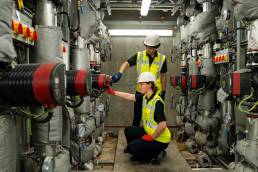
To address this, I worked on optimisation studies which involve analysing how a heating system currently operates, diagnosing issues and recommending the works required to improve the heat network’s performance. These studies come with an estimate of the energy savings and overall cost to support client business cases. I really enjoyed this work because the outcomes have a real positive impact on people’s day‑to‑day lives.
Problem‑solving has been a key part of my role, requiring me to investigate why networks were underperforming and develop realistic solutions to fix it. To do this, I would sketch schematics of the hydraulic layout of the plantroom and distribution systems and then in the office analyse the layout, estimate the heat losses and energy consumption and then determine the required works to improve its performance. This process made direct use of university knowledge in heat transfer, fluid dynamics, pressure losses and control strategy. A project that stands out from my time in compliance was a retirement housing block where our proposed works of moving from a 4-pipe to a 2-pipe system would lower the cost of heat by an estimated 70%. The most appropriate hydraulic arrangement for a communal heat network is via a “two-pipe” system where hot water for heating and domestic hot water are both supplied to the dwelling. Heating is then fed directly whilst hot water can be fed by a heat interface unit (HIU), which is a plate heat exchanger, or by a cylinder. A 4 pipe system is where heating and hot water are provided in two separate systems. This means the utility bills are very high as the additional pipework leads to significantly more heat losses. By switching from a 4-pipe to 2-pipe system, the heat losses can be decreased by tenfold.
Through this experience, I’ve learned that to be a good engineer you need to think about performance, feasibility and cost. Before my placement, my focus was usually on the engineering solution, which is of course very important, but you also need to consider the most cost-effective and impactful solution to minimise disruption to residents and clients alike. That is what makes engineering interesting – there is no one solution.
2. District Heating Design
Later in my placement, I moved into the District Heating Design (DHD) team, where I worked on the feasibility and early-stage design of large-scale, city‑wide heat networks. This was a very different type of work and allowed me to see the bigger picture of how heat networks can support the decarbonisation of UK cities.
I have mainly worked on a project with local authorities to assess opportunities for developing heat networks alongside new developments in city centres. This work is more conceptual and desk‑based, involving the use of mapping software and large Excel models.
My role involved analysing potential buildings that could connect to the network, estimating their heating and hot water demand, identifying suitable heat sources, and considering pipe routing and energy centre locations. Once an initial design is established, different options are tested to improve the financial and technical viability of the scheme. The financial analysis is carried out using a detailed techno‑economic model in Excel. Through this, my Excel skills improved significantly, from understanding model structure to troubleshooting errors and adjusting assumptions to produce financial outputs.
I have really enjoyed the process of presenting the results from this project. This involves clearly explaining our methodology, assumptions, and recommendations in a structured and evidence‑based way and I have learnt how to communicate complex technical ideas.
I have also enjoyed looking at how waste heat can be used in heat networks. Waste heat can be used from facilities such as data centres, wastewater treatment plants or energy‑from‑waste (EFW) sites. By reusing this waste heat to power homes, we can reduce carbon emissions and provide low-cost heat. My next project will see how an EFW plant in London can be used on a heat network with a large hospital connected.
3. Reflections on My Placement
Working in both Compliance and District Heating Design has given me a well‑rounded understanding of heat networks across their lifecycle, from fixing existing systems to designing future infrastructure. In Compliance, the work is highly people focused, where improvements directly affect residents’ comfort and energy bills. In District Heating Design, the focus is on long‑term impact, planning systems that could serve cities for decades while supporting net‑zero goals.
Being a good engineer means balancing detail with the bigger picture, and my placement at FairHeat has allowed me to do both. I’ve had the opportunity to work on projects end‑to‑end, develop confidence in my engineering judgement, and grow both technically and professionally.
I am extremely grateful to everyone at FairHeat for their support, guidance and willingness to share their expertise. Working in such friendly and knowledgeable teams has been a highlight of my placement, and I look forward to taking these skills and experiences back to university for my Master’s year.