87% Reduction
in Heat Loss

£100,000 Estimated
Annual Savings

30°C Drop in Return Temperatures
Helping Great Places Housing Association upgrade an ageing system with better comfort, lower losses and more transparent billing to support their residents
Background
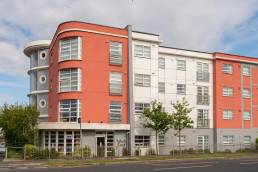
Hutton Lodge is a 28-home residential scheme in Manchester for people aged over 60. Built in 1989, the development relied on an ageing communal heating and hot water system that had become increasingly difficult to manage efficiently. The site was served by a 4-pipe heat network, with a pair of pipes taking warm water to point of use for hot water, and the other pair for space heating. Heat was distributed into flats on a single-pipe service, which reconnected back into the flow pipe.
There were five space-heating risers and six domestic hot water risers distributing heat throughout the building from the attic down to flats. Three gas-fired boilers in the plant room supplied both the heating network and an indirect domestic hot water calorifier. While some plant room equipment had been updated around 2019, the wider system was still causing major problems. For Great Places, this meant rising inefficiency and growing reliability concerns. For residents, it meant a system that often struggled to provide the comfort, control and consistency they needed.
Challenge
FairHeat played a key role in helping Great Places turn Hutton Lodge’s ageing heat network into a system that works better for everyone. By leading the optimisation, design, delivery and quality assurance of the project, FairHeat helped create a solution that was technically stronger, more practical, more efficient and more resident-focused.
The upgrade was designed to solve several problems at once: overheating, poor reliability and high energy costs. Old space-heating pipework was replaced to improve resilience, and the system was converted from a 4-pipe network to a simpler, more efficient 2-pipe low-temperature hot water system. Insulation was improved to reduce wasted heat, and the domestic hot water distribution network was removed. Thermal storage was also added to improve the efficiency of heat generation, while new water quality equipment was installed to support long-term performance.
The biggest difference was felt inside residents’ homes. Thermostatic controls were installed in every room, giving residents much better control over their comfort and helping to reduce wasted energy. Heat interface units (HIUs) were also fitted in every dwelling. These units produce hot water instantly, which reduces legionella risk. They also make accurate metering possible, so residents can be billed more fairly based on what they use. In other words, FairHeat’s work did not just improve the system behind the scenes; it improved how heat is delivered, controlled and paid for every day.
FairHeat Solution
FairHeat played a key role in helping Great Places turn Hutton Lodge’s ageing heat network into a system that works better for everyone. By leading the optimisation, design, delivery and quality assurance of the project, FairHeat helped create a solution that was technically stronger, more practical, more efficient and more resident-focused.
The upgrade was designed to solve several problems at once: overheating, poor reliability and high energy costs. Old space-heating pipework was replaced to improve resilience, and the system was converted from a 4-pipe network to a simpler, more efficient 2-pipe low-temperature hot water system. Insulation was improved to reduce wasted heat, and the domestic hot water distribution network was removed. Thermal storage was also added to improve the efficiency of heat generation, while new water quality equipment was installed to support long-term performance.
The biggest difference was felt inside residents’ homes. Thermostatic controls were installed in every room, giving residents much better control over their comfort and helping to reduce wasted energy. Heat interface units (HIUs) were also fitted in every dwelling. These units produce hot water instantly, which reduces legionella risk. They also make accurate metering possible, so residents can be billed more fairly based on what they use. In other words, FairHeat’s work did not just improve the system behind the scenes; it improved how heat is delivered, controlled and paid for every day.
Results
The design review process reduced capital expenditure of more than £7,000 per dwelling through smaller plant, pipe sizes and the change from indirect to direct HIUs. In addition to capital cost savings, with the improved efficiency of the heat network, the residents save an estimated £120 per year on bills with customer bills typically lower than £5 per week.
Changes made during FairHeat’s Acceptance Testing process saw return temperatures from 55°C to 32°C.
Since handover in 2018, the network has consistently operated with flow temperatures of 60C, even during the winter months. In addition to low flow temperatures, the average return temperature throughout the last year has been 32C. On occasion this temperature drops to below 30C. Network heat loss per dwelling of 71 W/dwelling during the summer have been recorded while the scheme was fully occupied, which is significantly below the recommended value of 100 W/dwelling recommended in CP1 2020.
The low temperature design means that the scheme is future-proofed. The scheme can be easily converted to run on other low temperature renewable technologies such as heat pumps, converting to a heat pump will require no other modifications to the system.